I am 20 years old, majoring in physics at the University of Gothenburg, Sweden.

I have over three years of experience developing software such as scientific algorithms, data analysis programs and videogames. I am proficient in languages such as Lua, Python, Ruby, and MATLAB.

During my time developing Roblox games I have scripted systems, built interfaces, and created graphical assets for games that accumulated half a million visits and generated thousands of USD.

I face major mathematical challenges in scripting head on to come up with efficient solutions for complex simulation problems such as collision detection and vehicle physics, as well as the networking challenges that come with it.
[LUAU] Semi-newtonian flight simulator with client-sided prediction and server reconciliation

A system of scripts consisting of over 10 modules used in my spaceflight simulator Raspberry Blueshift.

Client reads user input and predicts the spaceship's movement, and the server receives the same inputs through a deliberate input buffering system. Ship state (position, velocity etc.) is stepped forward by the same flight model on both server and client side.

Server-side and client-side states naturally converge as they both use the same physics module (also written by me), but they drift apart over time due to floating point error. This is mitigated by making small, smooth corrections on the client side, listening to the server as the only authority.

This leads to very smooth gameplay for the local player, while the server's authority over client ensures consistent PvP and guards against exploiters.

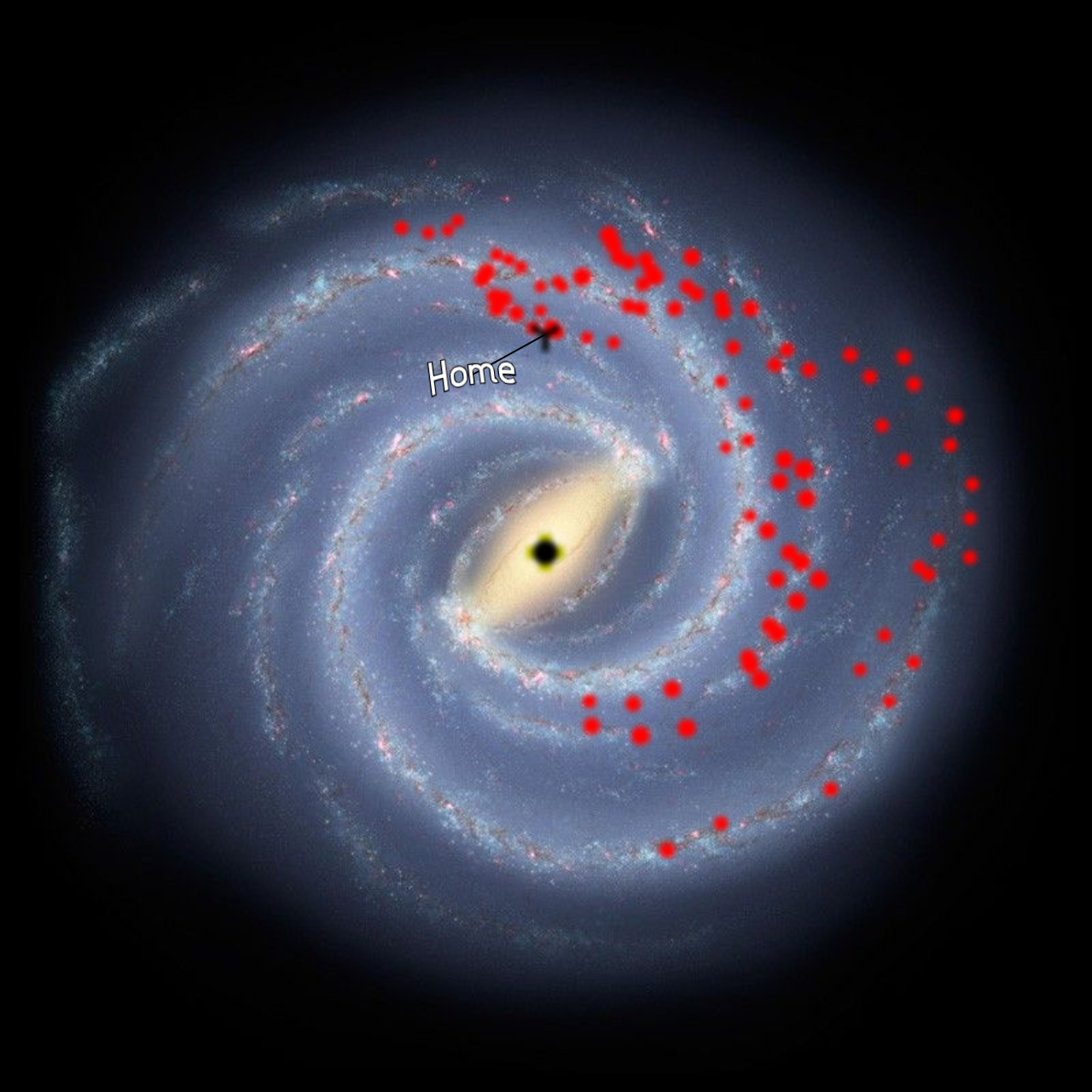
A scatter plot featuring hydrogen clouds overlaid on a render of the Milky Way galaxy. [PYTHON] Astronomical algorithm for detecting hydrogen gas clouds in the Milky Way galaxy

An algorithm written in Python used to analyze astronomical data of interstellar hydrogen clouds collected with a radio telescope.

I wrote it for a project in which I used a radio telescope to look at emissions of radio waves of wavelength 21cm, which originate from large clouds of neutral hydrogen in deep space, billions upon billions of kilometers away from planet earth.

The algorithm iterates through a series of DSV files and systematically detects points of interest in intensity, each representing a cloud. Using the doppler effect we can obtain their velocity relative to us. Using the milky way's rotational curve we can then use basic trigonometry to determine the clouds' locations in cartesian coordinates which can in turn be plotted as seen in the image (each red dot represents a cloud scaled by its intensity).

The plot with red dots is overlayed on top of NASA's artistic rendition of the Milky Way galaxy grounded in similar radio-astronomical experiments. Hydrogen clouds are where stars are born, meaning that their locations corresponds to the brightest parts of the galaxy. The spiral shape in the plot is evident.

[NOTE]
The left part of the galaxy is uncharted. This is due to my own personal geographical location; the portion of the sky visible from Sweden does not include those blank parts of the galaxy in September, making it impossible to collect data from galactic longitudes 240-360 at the time of the experiment.

Rate My Music

A social hangout game that used the Spotify API to display your listening activity in-game. I scripted several front-end aspects and was responsible for the game's UI. After a few months of being online, Roblox's chat update hurt the game's social aspects immensely and it ended up shutting down.

Project E.G.O.

An upcoming PvP focused RPG with parry-focused combat, based on the world of Project Moon. My responsibilities involve UI, building, story writing, miscellaneous graphic elements and front-end code.